
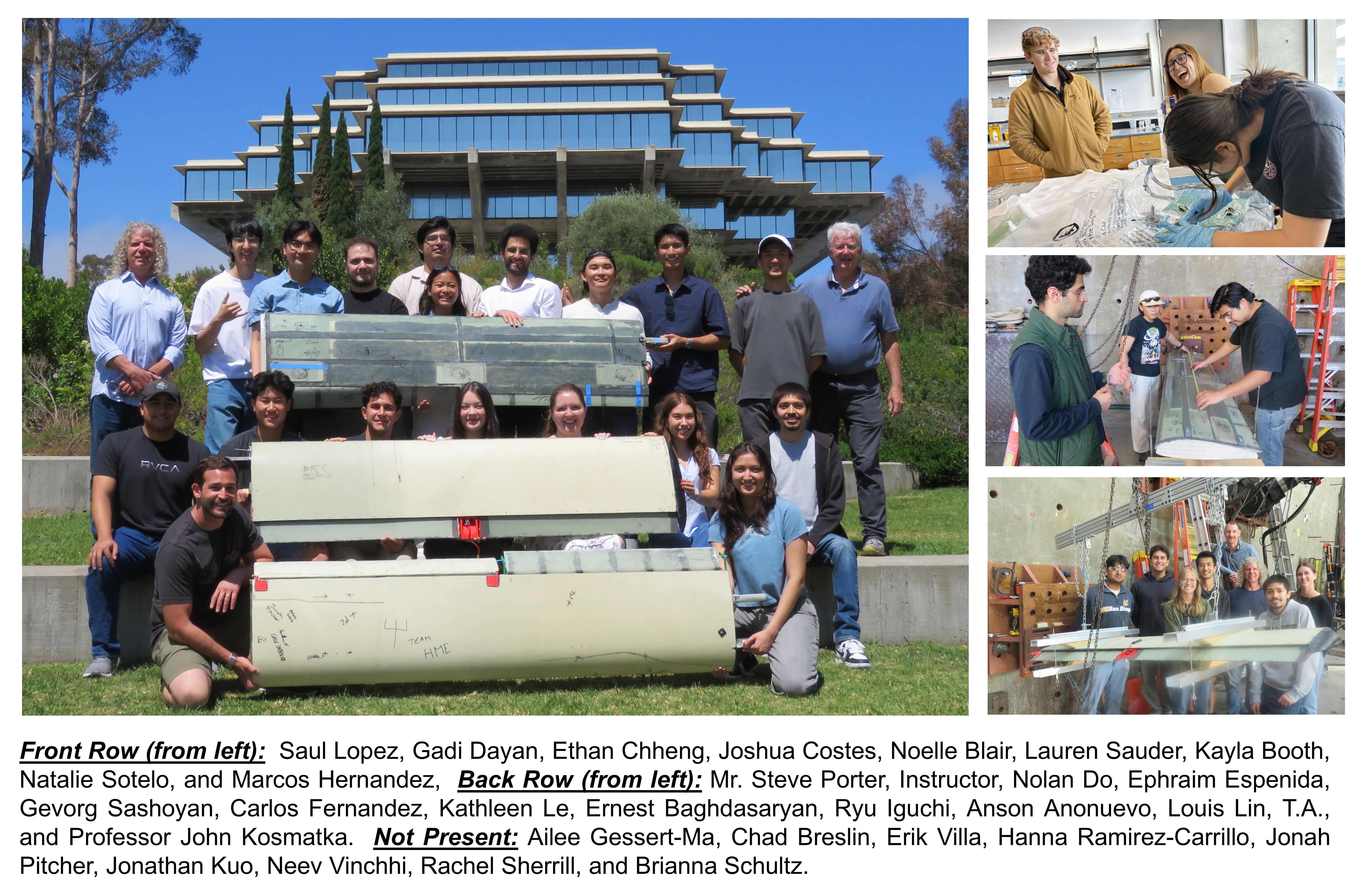
The SE 143 capstone sequence has long stood as the aerospace structures proving ground for structural engineering students at UC San Diego. This year, under the instruction team of Professor John Kosmatka, Mr. Stephen Porter, Brianna Schultz, and T.A. Louis Lin, three teams of undergraduates completed a ground-up aircraft redesign, followed by the fabrication, and failure testing of a composite aircraft wing for a single-seat personal aircraft.
THE PROJECT
Three teams were each issued a formal Request for Proposal (RFP), tasking them with a preliminary design for a new single-seat personal aircraft and the full development of its composite main wing. The baseline reference aircraft was the 1970s-era single-seat aluminum BD-5 micro-jet, made popular in James Bond’s (1983) movie entitled “Octopussy.” The premise of this year’s project was straightforward: using modern aerospace materials, analysis methods, and computational tools, students will develop a lighter, stronger, cheaper, and safer wing. Working from the Eppler 1230 airfoil selected through prior wind-tunnel testing, each team designed a 6.5-foot advanced composite wing complete with a functional aileron and flap, sized to meet FAA certification requirements.
The program progress was structured around six aerospace-grade formal reviews - Mission Concept, Preliminary Design, Critical Design, Manufacturing Readiness, Test Readiness, and System Acceptance - each requiring written documentation and a presentation evaluated by faculty and industry/Government representatives. This structure mirrors the program management process students will encounter in industry, and it kept every team accountable at each phase of the project.
Manufacturing the wing required each team to optimize the selection of glass-epoxy and carbon-epoxy composites, and the balsa and Core mat core materials to fabricate the upper and lower wing skins, the front and rear wing spars, and the wing ribs - all while managing layup schedules, cure cycles, and review deadlines in parallel. Teams also designed and built the mechanical linkages needed to actuate the flap and aileron, which were confirmed to function during the simulated worst-case aerodynamic loading (applied using a load distribution whiffle tree system). Instrumentation captured displacement and strain on the wing skins and spar caps for direct comparison against analytical predictions. A recurring challenge was buckling in the upper wing skins and spars that occurred as a result of the extreme simulated aerodynamic lift loads, requiring teams to identify deficient regions and reinforce them before the finished wing reached the test wall.
The resulting technical deliverables were substantial. Initially, the teams wrote MATLAB simulation programs to study the in-flight static and vibration structural response, and flutter behavior of their wings, and then they performed hundreds of iterations to optimize their design. Next, the teams built detailed finite element models using ABAQUS to predict the static and vibration structural response, correlating those results against experimental data collected in the Powell Structural Systems Laboratory. With critical support from Lab Manager Mike Sanders in test setup and data acquisition, each wing underwent free vibration testing using triaxial accelerometers provided by Professor Georgios Tsampras to extract natural frequencies, followed by static qualification testing using a whiffletree load distribution system through proof and ultimate load conditions. Across the two quarters, students developed skills in structural design and analysis, composite manufacturing, experimental testing, and formal engineering presentation - the full range of what it means to take a structure from concept to FAA certification.
The students and the instructor team are indebted to the industry/Government review team composed of: Ben Martins, PhD (ATA Corp), Doug Grose, PhD (Blue Origin), Citra Ie, PhD (Composite Consultant), Frank Belknap (retired, General Atomics), David Berger (NASA Aeronautics), Geoff Appuhn (Northrop Grumman), Eduardo Velazquez (SpaceX), and Zachary Green (US Navy, North Island).
FROM THE TEAM LEADS
Team NDA - Nolan Do, Team Lead
"My name is Nolan Do, and I had the privilege of leading Team NDA through a clean-sheet redesign and fabrication of a composite aircraft wing. Over the course of the year, we pushed through months of analysis, design reviews, manufacturing, and testing. Leading this project meant navigating real-time challenges on the floor - shifting deadlines, unpredictable material behavior, and manufacturing decisions that had to be made without the luxury of time. Taking a wing from initial concept to a physical structure is a feeling that is difficult to describe, but I know it has made me a better engineer - one who makes faster decisions when problems arise and works to prevent them from occurring in the first place.
I was not originally selected as team lead, but my teammates saw something in me and chose me for the role. Through this project I gained confidence, broadened my technical range across disciplines, and built friendships that will last. It also led me to employment in an industry I am genuinely excited to be part of. I am proud of what we accomplished, and I know this team is destined for great things. Ad astra per aspera."
Team IRIS - Lauren Sauder, Team Lead
"My name is Lauren Sauder, and I served as team lead for Team Iris - named for one of Instructor Steve Porter's former flight instructor, a pioneering woman in aviation who flew virtually every aircraft available during World War II. That name set the tone for who we wanted to be as a team. Our aircraft concept was designed to support humanitarian missions: delivering aid to remote areas and assisting with wildlife disaster prevention. Even for a hypothetical design, we wanted the work to serve a real purpose. Over two quarters, our nine-member team designed, manufactured, and tested a 6.5-foot composite wing, dividing responsibilities across MATLAB coding, ABAQUS finite element modeling, and hands-on fabrication. I was hesitant to take the lead role - managing nine people on a project of this scale is genuinely demanding - but I also saw it as a chance to represent the women in engineering who are not always offered leadership positions, and to make them proud. The end result of our wing made all of the effort worth it, and I am grateful for the connections made and the engineering instincts this project sharpened."
Team HME - Gadi Dayan, Team Lead
"My name is Gadi Dayan. I hold a B.S. in Structural Engineering with a focus in aerospace structures and am currently pursuing my M.S. in the same field. As a first-generation college graduate, husband, and father, this capstone represented more than a course requirement - it was the application of years of study to a real engineering problem with real constraints. Our team focused on minimizing the structural weight while maximizing performance. Our wing used fiberglass-epoxy composite skins with a 2 mm foam core. We went through the full cycle: preliminary design, structural analysis, manufacturing, assembly, and qualification testing, all within a compressed timeline. Our final results did not fully meet every original performance target, and that is its own kind of lesson. The experience offered a realistic view of what aerospace development actually looks like - the iterations, the trade-offs, and the discipline required to push a project across the finish line regardless. We are proud of what we built and grateful for the opportunity."
LOOKING FORWARD
The work produced in the SE 143 capstone this year reflects what is possible when students are given the structure, accountability, and scope of a real program. Three teams. Three wings. One course that asks students to be engineers before they graduate. For industry/Government partners, alumni, and collaborators interested in engaging with future cohorts – whether through design review panels, sponsored challenges, or project partnerships - we welcome the conversation. The next generation of structural engineers is already building. Contact the Department of Structural Engineering at UC San Diego to learn more about collaboration opportunities.